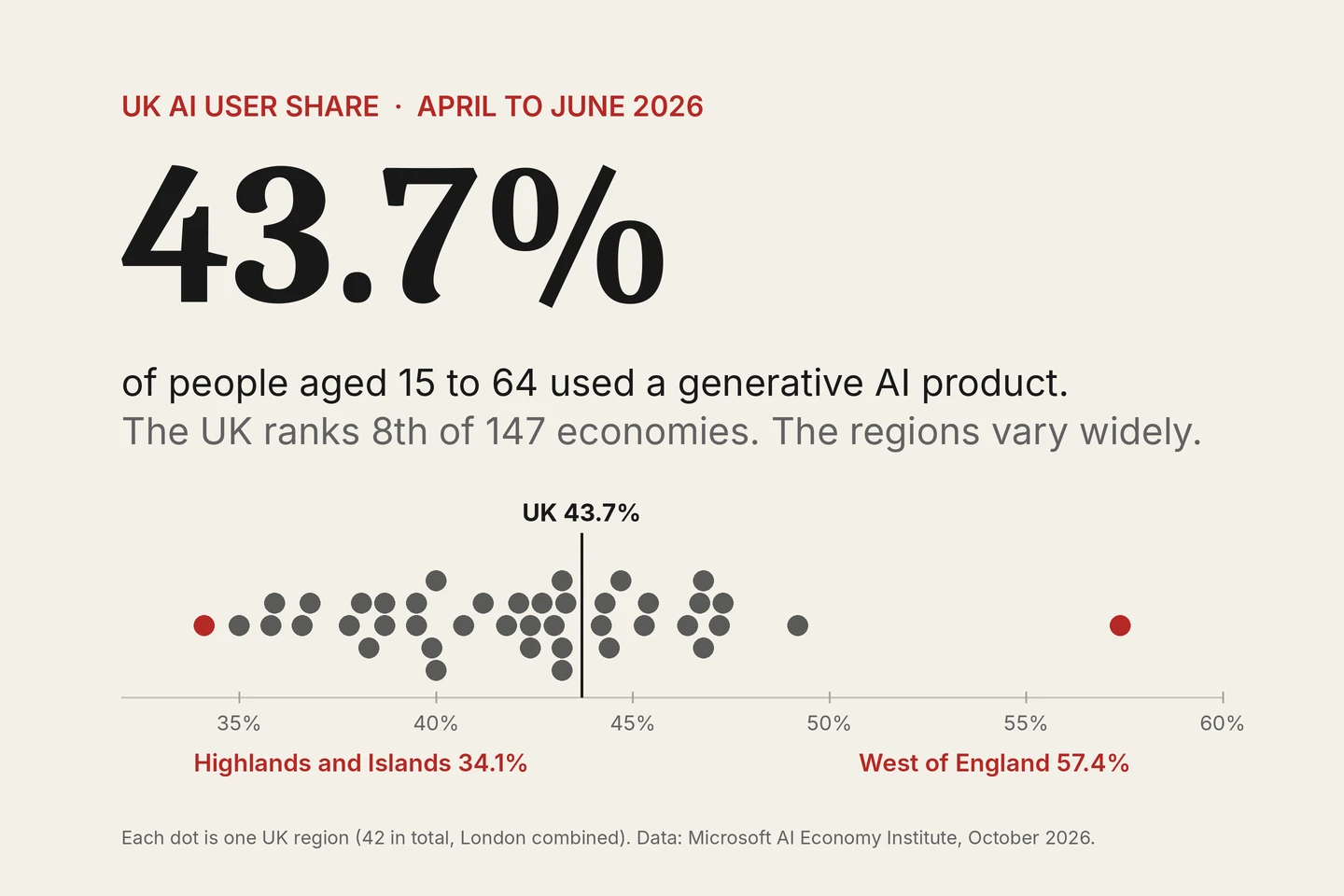
Microsoft's AI Economy Institute has published a report on AI diffusion in the UK. The headline: 43.7% of people aged 15 to 64 used a generative AI product between April and June 2026.
That puts the UK eighth out of 147 economies, and second in the G7 behind France. The US sits 21st, on 33%.
It's a big national figure. But most of the report is about what that average hides, and a lot of it lands close to home for schools and trusts.
Growth is slowing
UK use has climbed from 36.6% in the first half of 2025 to 43.7% now. But the quarterly gain halved, from 3.3 points in January to March to 1.5 points in April to June.
One quarter isn't a trend. Still, it hints that the keen adopters are already on board, and the next group will need more than a login and a link to a training video.
A 23-point gap between regions
The report maps 42 UK regions. Bristol, Bath and the wider West of England come top at 57.4%. The Highlands and Islands are at the bottom on 34.1%.
Cumbria, Cornwall and the Isles of Scilly, North Wales and Suffolk make up the rest of the bottom five. Rural, spread-out places, mostly.
The strongest link is with the share of young adults in a region. Professional jobs and population density follow close behind. Microsoft is clear that these are correlations, not causes. Moving to Bristol won't make you use AI.
For a trust with schools in a city and schools out in the county, it's worth a look. Staff in different schools may be starting from very different places, and one training plan for everyone could miss both ends.
A lot of AI use is invisible to employers
This is the section I'd share with any senior leadership team. The report draws on a Deloitte survey of 25,000 UK working adults, carried out in May and June 2026.
Of the workers using generative AI, 31% said they used it without their employer knowing. 46% used free tools. And 17% paid for at least one work tool out of their own pocket.
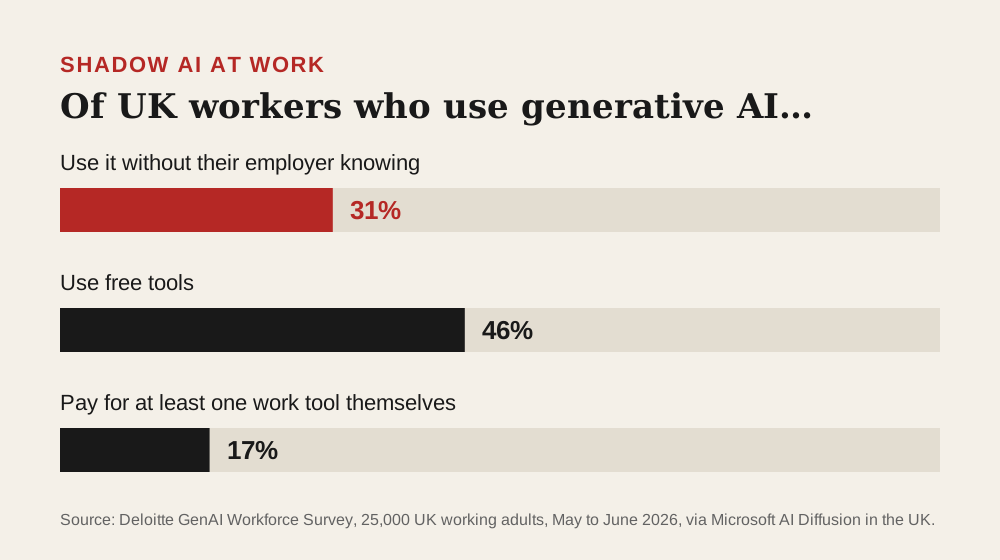
The report calls this shadow AI. In a school, it might look like a teacher pasting assessment notes into a free chatbot to draft report comments, on a personal account, with nobody aware it happened.
Free consumer tools can have very different terms on how data is stored and whether it's used for training. If pupil information is going into them, that's a question for your Data Protection Officer. A ban on its own probably won't make the use disappear. It'll just make it harder to see.
A better starting point is finding out what's being used. An anonymous staff survey asking which tools people use, and for what, will tell you more than a policy document. Then give staff an approved option that does the job. There's more on choosing one in Before you buy that AI tool.
Most use is still the simple stuff
Searching for information and drafting emails were the most common uses in the Deloitte survey, each mentioned by 43% of users. Summaries came next at 31%. Only 24% of workers used generative AI every day.
Businesses look similar. The Office for National Statistics found that firms using AI averaged 1.6 AI technologies in 2026, up from about 1.4 in late 2023.
Microsoft argues the bigger productivity gains come when organisations redesign how work gets done across a whole process. In school terms, that might mean a trust looking at how reports, cover or admissions work end to end, and where AI fits into each step.
Smaller organisations are behind
Large businesses with 250 or more staff reached 44% AI uptake by 2025. Firms with fewer than 50 staff were on 26%.
A small primary school with no dedicated IT team probably has more in common with the second group. In a trust, the central team is well placed to make sure smaller schools aren't left to work it out alone.
The report also points to research showing women adopt AI more slowly and less intensively than men. Most of the education workforce is women, so any staff training plan should take that gap into account.
Read it with the caveats
The headline figures come from Microsoft's own usage data, adjusted for device and broadband access. They show whether people used a generative AI product. They can't show whether people used it well.
It's also Microsoft measuring a market it sells into. The report is open about its method and leans on ONS, government and Deloitte data too, but it's fair to keep in mind.
And some regional ranks are very close. Microsoft itself says small differences between neighbouring regions shouldn't be read as real differences.
So use the figures to start a conversation, then go and get your own numbers.
Do you know which AI tools your staff used this week, and whose account they used them on?