
Another day, another survey, another statistic.
This one is from HP. The HP Futures 2026 report, Skills in the Age of Intelligent Machines, runs to 120 pages. It draws on a council of 58 education, policy and Future of Work leaders, plus a survey of 6,206 students across 37 countries.
I nearly scrolled past it. I'm glad I didn't, because one number in it belongs on every staffroom wall.
82% of students are worried
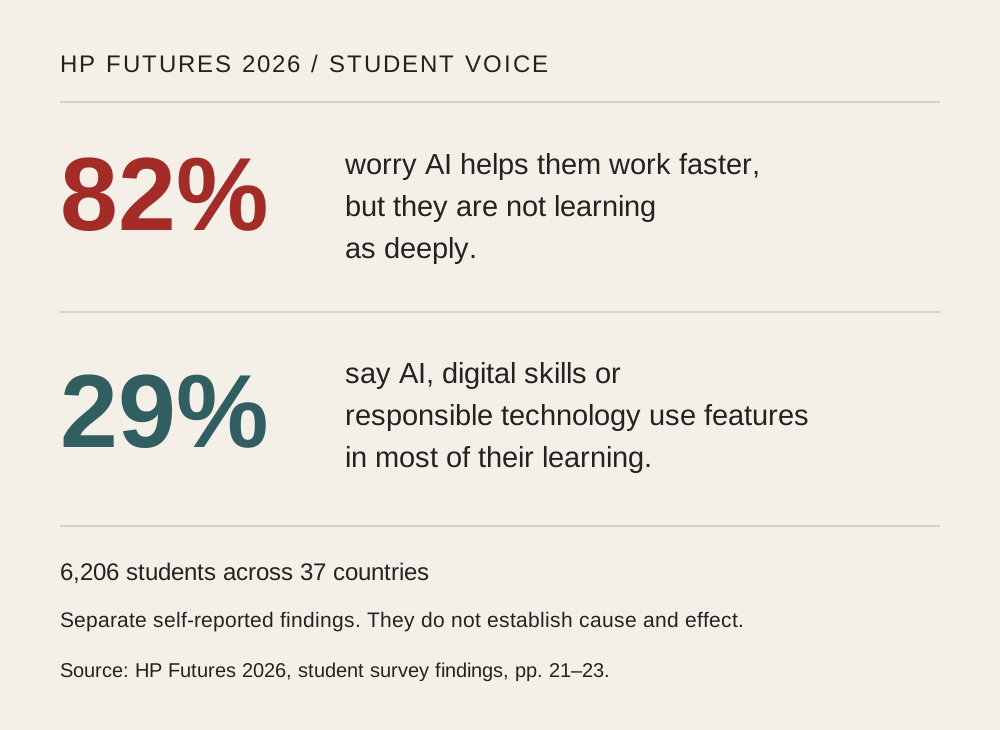
82% of students worry that AI helps them work faster, but they aren't learning as deeply.
That concern cleared 75% in every major country surveyed. It peaked at 90% in Indonesia.
Now look at the other side of the ledger. 80% of the same students feel confident they'll use AI effectively and responsibly in their careers. 81% believe their education is preparing them for work.
So they trust their own skill with the tool. And they're worried about what it's doing to their thinking.
The report calls this a paradox. I'd call it self-awareness. Teenagers are telling us the shortcut has a cost.
One council member, Alper Utku of Amsterdam Tech, put it bluntly. The Industrial Revolution took away physical work and gave us obesity. Take away cognitive work and you risk "mental obesity".
Grim. Memorable, though.
What students asked for
HP ended the survey with one open question. If you could give one message to education or workplace leaders about preparing students for an AI-driven future, what would it be?
6,185 students answered, in six languages. The same theme came back from every region. Teach us to think with AI. Don't let it think for us.
They asked for AI education over AI bans. Many warned, in their own words, against dependence and "lazy thinking".
A 16-year-old in the United States summed it up in one line:
Know how to use AI before AI knows how to use you.
A 17-year-old in Brazil wrote what reads like a job description for the next decade:
Courage to ask what no one has asked. Humility to test something 20 times with AI until it works. Character to decide when to switch the AI off and take responsibility on your own.
I'd happily put that second one in front of any adult team rolling out Copilot.
Broad but shallow
Here's where schools come in. 88% of students say their learning includes at least some AI, digital skills or responsible technology use.
Only 29% say it features in most of their learning. Over a third report few classes, none at all, or don't know.
So AI is in the building. It just hasn't made it into the timetable in any depth.
Students also ranked the skills they think will count most in future jobs:
| Skill | Students choosing it |
|---|---|
| Creativity | 56% |
| Critical thinking | 56% |
| Communication and collaboration | 52% |
| AI and digital literacy | 44% |
| Technical or coding skills | 29% (ranked eighth) |
Coding in eighth place. Read that twice if you sat through the "every child must code" years.
And when learning really counts, 25% of students prefer handwritten notes. Only 18% prefer AI-generated summaries. Nearly half (49%) chose a method involving handwriting or print.
I'll leave you to decide whether a printer manufacturer finding that students like printing things is a coincidence.
What HP's recruiters are seeing
The employer section is the most practical part of the report.
Kymberly Flaigg leads HP's global graduate recruitment. She says intern work has changed. An intern used to tidy a spreadsheet or consolidate data. Now HP expects them to connect several data sources, automate the workflow, notify suppliers and anticipate risks.
Her line: "It's not just counting anymore. It's actioning past the counting."
From the start of HP's 2027 financial year, every employee, interns included, gets a Copilot licence.
Interviews have changed too:
- All virtual interviews have been on camera since 2025, with recruiters trained to spot AI-assisted answers
- Pre-screens ask unpredictable questions about what candidates have actually built
- AI fluency is tested by depth: which tools you use, why you picked them, how they differ and how you check the output
Flaigg also says cutting early-career hiring would be "a huge mistake", because graduates are the people who'll build and own the next generation of AI-enabled work.
She and her colleague Martin Stier give education systems three to four years to start teaching and credentialing these skills properly. After that, they expect demand to outstrip what self-taught graduates can supply.
Read it with your eyes open
A few caveats before this lands in every INSET deck.
HP describes its own survey as "a global listening exercise". It doesn't replace national data. 88% of respondents were aged 12 to 17, and there's no UK breakdown.
It's also a report from a company that sells laptops and printers to schools. That doesn't make it wrong. It does mean you should read the conclusions with the sponsor in mind.
But the headline finding doesn't lean on HP for its credibility. It's students describing their own learning, and it sits comfortably alongside the cognitive offloading research we've seen over the last couple of years.
Two ideas worth stealing


The first is "choicefulness". Ugly word. Useful idea.
The report wants it recognised as a durable skill, alongside accountability. It means knowing when to use AI, when to leave it alone, and owning the result either way.
The council suggests students ask themselves a handful of questions before they reach for a tool:
- What purpose is AI serving in this task?
- What should I think through before I involve it?
- How will I verify the output?
- Where does my own judgement come in?
- When should I ignore it completely?
That's a ready-made reflection prompt for any classroom or training room.
The second is assessment. The report calls it the biggest bottleneck and the biggest lever. It wants a shift from one-off exams to evidence of process: portfolios, reflections, artefacts, feedback cycles and a record of how AI was used.
Its sharpest line says assessment must "distinguish cognitive amplification from cognitive offloading."
Apprenticeships already work a version of this. End-point assessment leans on portfolios and professional discussion, where the apprentice has to explain what they did and why. Asking how they used AI, and where they overruled it, is a short step from there.
So, just another statistic?
Maybe. But this time it's the students' statistic.
82% of them say AI is making their learning thinner. 29% say AI and digital skills feature in most of their lessons. Put those two numbers side by side and the job for schools, colleges and training providers looks fairly clear.
If your learners told you this tomorrow, what would you change first?
Read the full report: HP Futures 2026, Skills in the Age of Intelligent Machines (PDF)